Listen to this article
Click play to start listening
Introduction
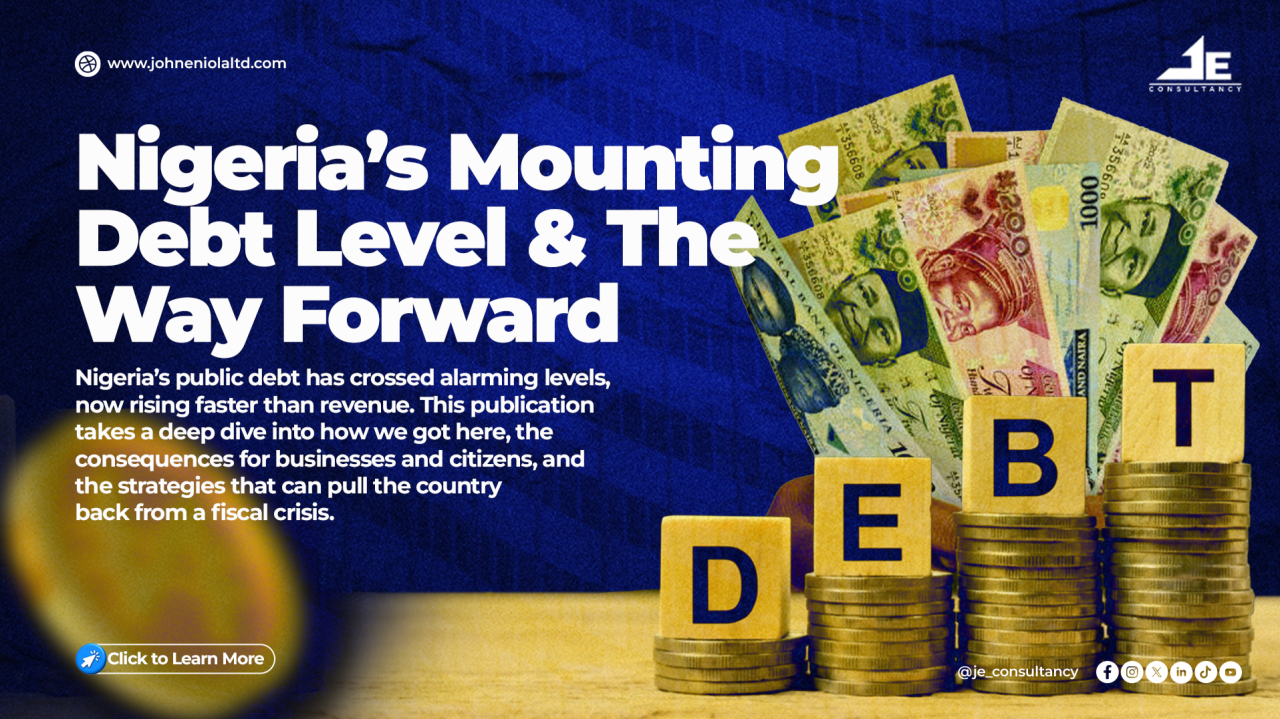
Nigeria's public debt has reached worrying levels, threatening economic stability and growth. Today, we will look at the changing debt situation, identifying the reasons behind its fast rise and the serious effects on our economy.
The costs of paying back debt now exceed government revenue, creating a risky financial situation.
Immediate action is crucial to prevent long-term economic decline and worsening social problems.
Definition of Terms
To understand fully the complexities of Nigeria's debt situation, it is essential to establish a foundational understanding of key economic concepts related to public finance. These definitions are crucial for both a general understanding and an in-depth analysis.
External Debt
Financial liabilities owed by residents to non-residents, affecting national liabilities without equity or derivative contracts.
Internal (Domestic) Debt
Debt owed to domestic lenders, primarily through treasury securities. This method is less inflationary than direct money creation.
Understanding Public Debt: Key Concepts
Public Debt
This encompasses all external obligations of public debtors, including national, state, and local governments, as well as publicly guaranteed private debts.
Debt-to-GDP Ratio
This is a measure of a country’s debt relative to its economic output, indicating its ability to repay its debt obligations. It is calculated by dividing a nation’s total debt by its Gross Domestic Product (GDP). A higher ratio can suggest a higher risk of default, while a lower ratio may indicate greater financial stability.
Debt Servicing
The total amount needed to repay debt, including principal and interest. High debt servicing can limit funds for development and negatively affect currency value, especially when foreign exchange is required for external debts.
Interest Payments
Governments typically pay interest on their debt, which is a cost that can affect future budgets and spending priorities.
Deficit
In simple language, this occurs when a government's expenditure exceeds income receivables within a fiscal year. The associated interest payments on deficit financing can influence future budgets.
Surplus
The opposite of a deficit, a surplus occurs when a government's income exceeds its expenditure, thereby making the repayments of debts easier and thus making allowance for repayments of existing debts.
Nigeria's Evolving Debt Landscape
Historical Context
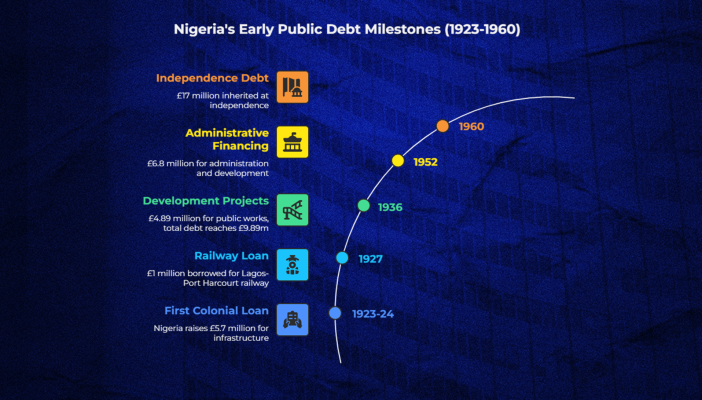
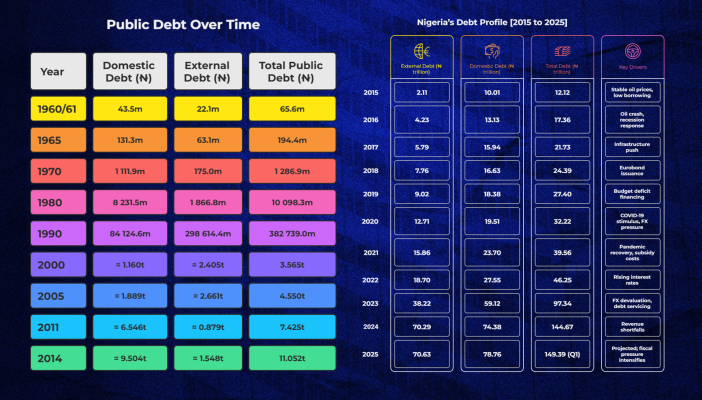
Nigeria's journey with public debt began during the colonial era, with the first recorded instance of public borrowing occurring between 1923 and 1924. The country faced a significant debt crisis in the 1980s and 1990s, characterised by a heavy reliance on external borrowing, declining oil revenues, political instability, and widespread mismanagement of public resources. A pivotal moment arrived in 2005 with the Paris Club debt relief agreement, which resulted in the cancellation of approximately $18 billion in external debt. This relief substantially reduced Nigeria's debt-to-GDP ratio to a low of 7.3% in 2008. The agreement was partly facilitated by Nigeria's adoption of an "oil-price-based fiscal rule" and concerted efforts to improve governance.
Current Debt Profile (2015-2024/Q1 2025)
Since Nigeria received debt relief, its national debt has grown significantly from around ?12 trillion in 2015, to N149 trillion by Q1 of 2025, an increase of over 1 000%. This rapid rise indicates that the main problems causing debt issues were either not completely fixed or have come back even stronger, quickly reversing the advantages gained from the debt relief.
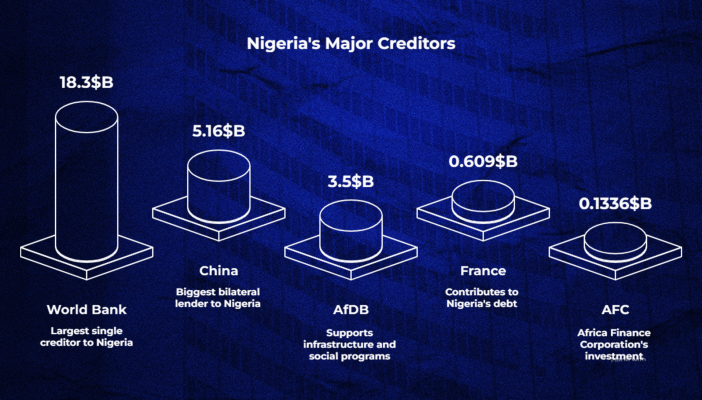
Some of Nigeria’s Creditors
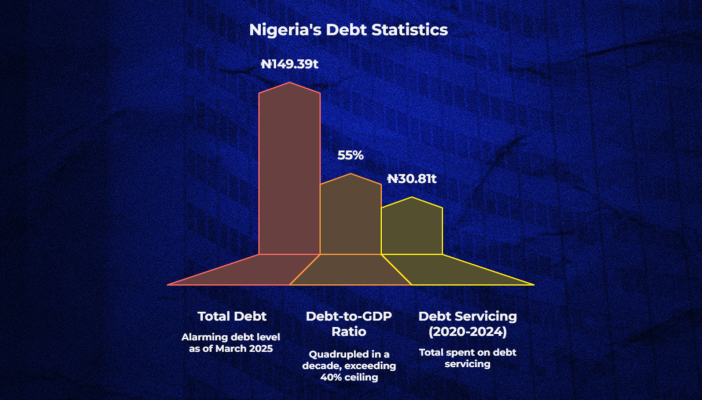
Some Vital Statistics
-
As at March 2025, Nigeria's total debt had reached an alarming ?149.39 trillion.
-
Nigeria’s debt-to-GDP ratio of about 55 % has quadrupled in a decade, breaching its own 40% ceiling.
-
Total spent on debt servicing between 2020 & 2024 stood at ?30.81 trillion.
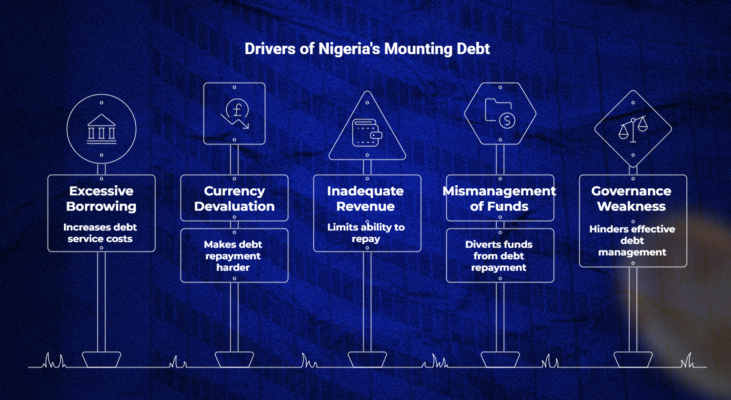
Drivers of Nigeria's Mounting Debt
A mix of economic, structural and governance issues are responsible for Nigeria’s rising debt. It is important to understand these issues in order to create effective solutions.
Consequences of High Indebtedness
Nigeria's growing debt is causing serious problems. These issues go beyond financial numbers; they also harm the economy and affect the lives of its people.
Some of the consequences of high indebtedness are:
Increased Interest Costs
A high national debt forces a government to allocate more of its budget to interest payments, diverting funds from essential services and investments in education, infrastructure, and healthcare.
Reduced Fiscal Flexibility
A high debt-to-GDP ratio restricts a government's ability to respond to economic downturns, limiting its capacity to implement necessary fiscal stimulus measures.
Slower Economic Growth
When government spending is primarily on debt servicing, it can crowd out private investment, hindering long-term economic growth. High debt often results in elevated interest rates, increasing borrowing costs for businesses and individuals.
Potential for a Fiscal Crisis
In extreme cases, a government's high debt can erode investor confidence, leading to a sharp increase in borrowing costs, a potential currency crisis, or even a sovereign default or insolvency.
The Way Forward - Strategies for Sustainable Debt Management
Addressing Nigeria's mounting debt requires a comprehensive and multi-faceted approach, focusing on both immediate fiscal adjustments and long-term structural transformations.
The strategies below, if employed could create a pathway for sustainable debt management:
Budget Cuts and Discipline
The government must control spending and improve budgeting. Strong systems for reviewing and monitoring projects are essential to ensure public funds are utilised efficiently and all loopholes leading to waste nipped. It is important to cut unnecessary expenses and redirect resources toward effective poverty reduction programs and impactful projects. Balancing improved spending with increased revenue is crucial; simply raising revenue will not solve the debt problem if spending issues remain unaddressed.
Enhancing Revenue Generation
Increasing the tax base, strengthening tax agencies, and implementing digital tax systems can improve reporting and collection. Data matching can increase compliance and reduce evasion. To raise the tax-to-GDP ratio, new taxes or reforms targeting wealth, consumption, and/or environmental factors may be needed for a fairer revenue system. These efforts aim to create a more efficient and equitable tax system to support public services and infrastructure.
Diversify Income Sources
Nigeria should reduce oil dependency and invest in agriculture, manufacturing, technology, and solid minerals. Enhancing agriculture will improve food security, while a robust manufacturing sector will create jobs. The technology sector encourages innovation, and developing solid minerals can generate revenue.
Anti-Corruption and Governance Reforms
Strong anti-corruption measures and enhanced transparency in government are essential. This involves improving legislative oversight of borrowing and equipping legislators to better analyse debt information. Establishing independent review mechanisms will ensure impartial assessments of debt management and public expenditure, boosting confidence and aligning legal frameworks with practical implementation.
JE Policy Recommendations
Economy Diversification
To build a stronger economy, we need to promote non-oil sectors like agriculture, manufacturing, and services. This will help create stable income sources and reduce the risk of damage from oil price changes. We can attract investments by offering tax incentives, improving infrastructure, and making regulatory changes. These steps will help us develop a more resilient and sustainable economy.
Targeted Investments
The government should focus its spending on important areas like education, health, and essential infrastructure. When borrowing money, it is vital to use such funds for projects that can generate economic benefits, rather than for ongoing expenses. This approach is essential to avoid falling into a "development debt trap," where poor spending choices slow down growth.
International Cooperation
Maintaining proactive engagement with multilateral financial institutions (e.g., International Monetary Fund (IMF), World Bank) and bilateral creditors is crucial to securing concessional loans, technical assistance, and support for reform initiatives. Exploring opportunities for debt renegotiation to secure more favourable terms, including lower interest rates and longer repayment periods, can provide much-needed fiscal space.
Strengthening Institutional Frameworks
The need to assess our debts regularly to ensure sustainability, and improve how public finances are managed at all levels of government is vital. Strengthening fiscal discipline and transparency in financial operations is crucial. This will help build public and investor confidence, which is necessary to attract sustainable investments.
Conclusion
Nigeria's mounting debt is a major challenge that requires decisive policy actions and sustained commitment to fiscal responsibility, economic diversification, and robust governance to tackle. The severity of the current fiscal situation, where debt servicing consumes a huge portion of revenue, demands immediate and comprehensive reforms to prevent a deeper economic crisis and unlock the nation's immense potential for inclusive growth and development.
Tags
Comments (0)
Leave a Reply
No approved comments yet. Be the first to comment!